
Insights/Milestone Inspection basics
What Is a Milestone Inspection in Florida? A Guide for Condominium Boards
A Milestone Inspection is a structural inspection performed by a Florida-licensed architect or engineer. This guide explains who it applies to, when it is due, how Phase One and Phase Two work, and what a board should organize if structural repairs are identified.
|8 min read
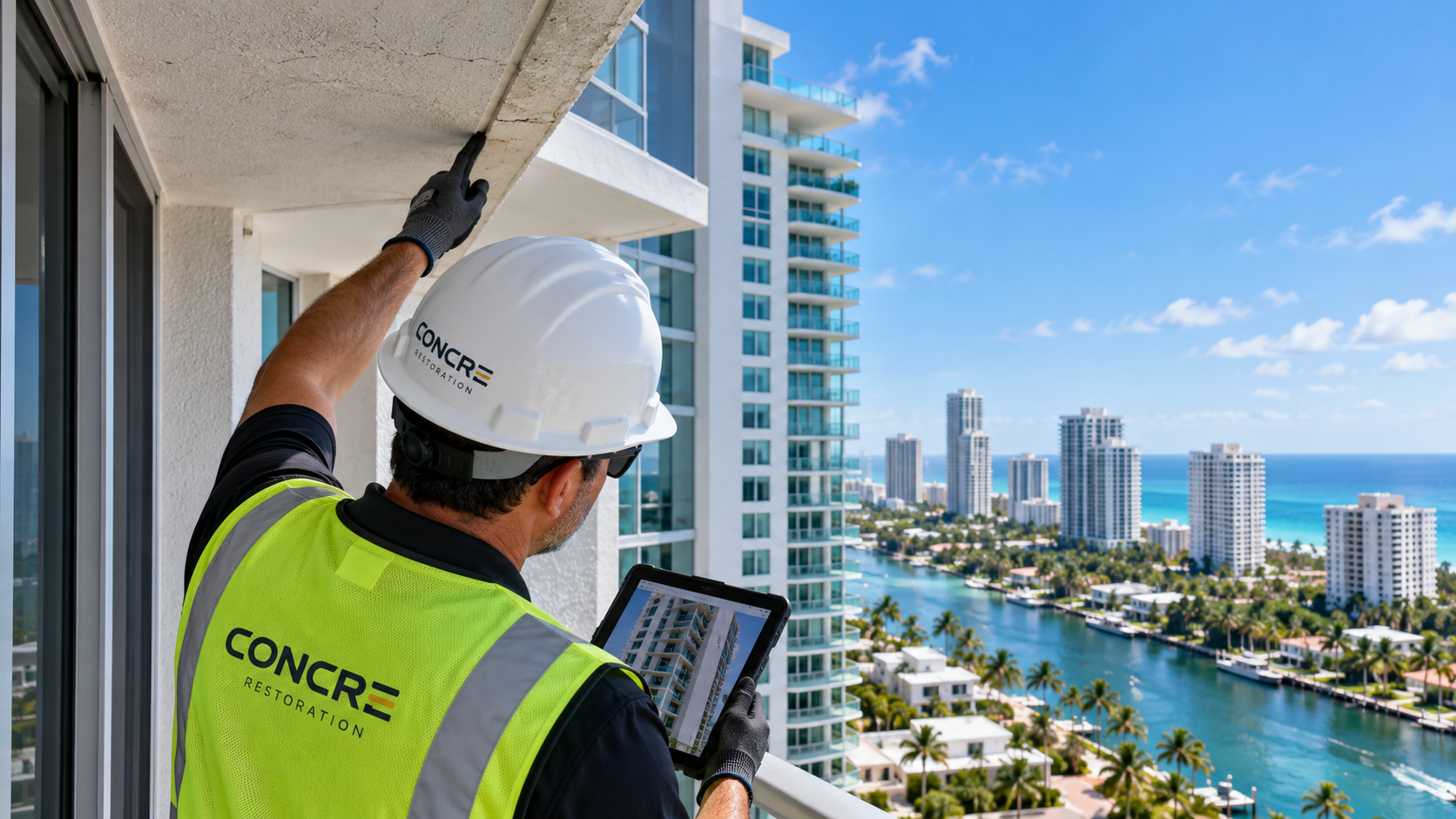
Condominium boards across Florida, including in Miami-Dade and other coastal counties, are hearing more about Milestone Inspections. The requirement was created by state law after the 2021 Surfside collapse and is now part of the normal life cycle of many residential condominium and cooperative buildings. For a board, the inspection can raise practical questions quickly: whether the building is subject to it, when it is due, who performs it, what the report means and what happens if repairs are identified.
This guide answers those introductory questions in plain terms. It is educational information, not legal or engineering advice. The statutory inspection is performed by a Florida-licensed architect or engineer. CONCRE is a restoration contractor: it does not perform Milestone Inspections, does not determine substantial structural deterioration and does not sign or seal inspection reports. Its role begins later, when approved engineering findings need to become measurable, executable restoration work.
Laws and local requirements can change. Associations should confirm current requirements with their local enforcement agency, legal counsel and qualified Florida-licensed professionals.
1. What exactly is a Milestone Inspection?
Under section 553.899 of the Florida Statutes, a Milestone Inspection is a structural inspection of a building, including an inspection of load-bearing walls and the primary structural members and primary structural systems. It is performed by a Florida-licensed architect or engineer for the purposes of attesting to life safety and the adequacy of the structural components and, to the extent reasonably possible, determining the general structural condition of the building as it affects the safety of the building.
It is equally important to understand what it is not. A Milestone Inspection is not an inspection for compliance with the Florida Building Code or the fire safety code. It is focused on structural condition, not on whether every component meets current construction standards.
2. Which Florida buildings are generally subject to it?
The requirement generally applies to residential condominium and cooperative buildings that are three stories or more in height, as determined by the Florida Building Code. The obligation falls on the condominium or cooperative association and, where applicable, on other owners of the building. Whether a specific building is subject to the requirement, and how its age is measured, should be confirmed with the local enforcement agency.
3. When is the first inspection required?
In general, the initial Milestone Inspection must be performed by December 31 of the year in which the building reaches 30 years of age, based on the date the certificate of occupancy was issued, and then every 10 years after that. A local enforcement agency may require the initial inspection at 25 years if it determines that local circumstances, including environmental conditions such as proximity to salt water, justify the earlier timing.
The process is triggered by the local enforcement agency, which provides written notice to the association. The association must then notify unit owners within 14 days of receiving that notice. Phase One of the inspection must be completed within 180 days after the association receives the written notice. Because local agencies administer these deadlines, boards should confirm the specific dates that apply to their building rather than relying on a general rule.
4. Who can perform the inspection?
The Milestone Inspection must be performed by a Florida-licensed architect or engineer. That professional observes the building, determines which areas require closer examination or testing, interprets the findings and signs and seals the report. A restoration contractor does not perform the statutory inspection or make its determinations. When a board retains professionals, it is useful to clarify early who will perform the inspection, who will prepare any repair documents, and who will serve as Engineer of Record (EOR) during construction if repairs are required.
5. What happens in Phase One?
Phase One is a visual examination of habitable and non-habitable areas of the building, including major structural components, conducted by the licensed architect or engineer. It provides a qualitative assessment of the structural conditions of the building. If the inspector finds no signs of substantial structural deterioration to any building components under visual examination, Phase Two is not required, and the Phase One report completes that inspection cycle.
6. When is Phase Two required?
Phase Two is required if substantial structural deterioration is identified during Phase One. Phase Two may involve destructive or nondestructive testing at the inspector's direction. The statute allows it to be as extensive or as limited as necessary to fully assess areas of structural distress, to confirm that the building is structurally sound and safe for its intended use, and to recommend a program for fully assessing and repairing distressed and damaged portions of the building.
If Phase Two is required, the inspector must submit a progress report and timeline to the local enforcement agency within 180 days after the Phase One report is submitted. Boards should expect Phase Two to involve closer access, coordination with residents and a broader review of specific areas than Phase One.
7. What "substantial structural deterioration" means, and what it does not automatically mean
In the statute, substantial structural deterioration means substantial structural distress or substantial structural weakness that negatively affects a building's general structural condition and integrity. It is a professional determination made by the licensed architect or engineer performing the inspection.
The definition expressly excludes surface imperfections such as cracks, distortion, sagging, deflections, misalignment, signs of leakage or peeling of finishes, unless the licensed engineer or architect performing the inspection determines that such surface imperfections are a sign of substantial structural deterioration. In practical terms, a board should not assume that every visible crack or stain means structural failure, and should not assume that it means nothing. Interpretation belongs to the inspector.
8. What does the final report tell the board?
Upon completion of Phase One and, where required, Phase Two, the architect or engineer prepares a signed and sealed report. The inspector also prepares a summary of the report. The report and summary are submitted to the association, to any other applicable owners and to the building official of the local government with jurisdiction.
Among other things, the report identifies any substantial structural deterioration and its extent within reasonable professional judgment, describes recommended repairs for that deterioration, and states whether unsafe or dangerous conditions were observed. It also recommends any preventive or remedial repairs for damaged items that do not constitute substantial structural deterioration, and identifies items that require further inspection.
Within 45 days of receiving the applicable report, the association has statutory obligations to distribute a copy of the inspector-prepared summary to unit owners, post it in a conspicuous place and, where the association is required to maintain a website, publish the report and summary there. Counsel can confirm how those obligations apply to a specific association.
9. What happens if repairs are identified?
Local governments must require that repairs for substantial structural deterioration be scheduled or commenced within a specified timeframe, and those repairs must be commenced within 365 days after the association receives the Phase Two report. That timeframe makes early organization valuable: repair documents, procurement, access planning and resident communication all take time.
Typically, the licensed professional's findings are developed into repair drawings and specifications that define repair types, limits, materials, testing and inspection requirements. Those documents become the basis for contractor pricing and execution. Our deeper articles explain how identified deterioration becomes a repair scope, and the step-by-step sequence from the report to close-out.
10. Milestone Inspection vs. SIRS
A Milestone Inspection and a Structural Integrity Reserve Study (SIRS) are different requirements with different purposes. The Milestone Inspection is a structural inspection of the building's condition. The SIRS is a reserve study used to plan funding for the repair and replacement of specified building components. Associations whose Milestone Inspection is due on or before December 31, 2026 may complete the SIRS simultaneously with the Milestone Inspection, but a SIRS cannot be completed after December 31, 2026 under that option. Boards should coordinate both with their professionals and counsel rather than treating one as a substitute for the other.
11. Where CONCRE fits after engineering findings
CONCRE is the restoration contractor. It is not the architect or engineer performing the statutory Milestone Inspection, and it is not the Engineer of Record unless a licensed professional is separately and lawfully engaged for that role. CONCRE does not determine substantial structural deterioration and does not sign or seal Milestone Inspection reports.
Our role begins when engineering findings and approved repair documents need to be converted into measurable restoration work: scope organized by location and repair type, pricing, access planning, phased execution, quantity tracking against the documented baseline, QA/QC and a close-out record. Field conditions that differ from the documents are reported to the EOR for direction rather than resolved as field design decisions.
CONCRE observes, maps and quantifies. The Florida PE evaluates, diagnoses and specifies.
12. Board checklist: before moving from inspection to restoration
- Confirm the statutory and local deadlines that apply to the building with the local enforcement agency.
- Retain an appropriate Florida-licensed architect or engineer, and clarify who will prepare repair documents and act as EOR.
- Organize prior structural, repair, waterproofing and maintenance records so the professionals can review them.
- Identify access constraints, occupied areas, parking impacts and areas that are difficult to reach.
- Distinguish the engineer-defined repair scope from contractor pricing, means and execution.
- Establish repair location IDs, measurement rules and a consistent photo documentation standard.
- Understand how quantities discovered during demolition and changed conditions will be reviewed and approved.
- Plan communication with residents about access, parking, noise, balcony closures and schedule updates.
- Define the close-out documentation the association expects to receive and keep.
Inspection creates information. Restoration converts it into controlled work.
A Milestone Inspection gives a board a professional, signed and sealed account of its building's structural condition. It does not, by itself, repair anything. When repairs are identified, the board's next task is to make sure approved engineering findings are converted into a located, measured and documented restoration program, executed within the required timeframe and with clear responsibilities. Boards that organize that process early are better prepared for every step that follows.
Related insights
More from CONCRE Insights.
Quantity control
How Are Concrete Repair Quantities Measured? From Inspection to Final Repair
You cannot control what you cannot quantify. Concrete repair quantities move from estimated to identified, verified and repaired. This guide explains how each stage is measured, documented and approved so owners can follow the scope with evidence.
Concrete spalling guide
Concrete Spalling in Florida Buildings: Causes, Warning Signs, and When Repair Is Needed
Spalling is visible concrete loss, but the condition behind it may extend beyond the broken surface. This guide helps Florida owners recognize what they can observe, what requires licensed professional evaluation, and how an engineered repair is controlled in the field.
Balcony restoration planning
Balcony Concrete Repair in South Florida: What Owners Should Know Before Restoration Begins
Balcony concrete restoration affects occupied units, repeated building elements, exterior access and repair quantities that become clearer at close range. The project is easier to control when scope, responsibilities and measurement rules are established before demolition.
Next step
Milestone Inspection Repairs
See how CONCRE converts approved engineering findings into a located, measured and documented restoration scope under the Engineer of Record's direction.