
Insights/Quantity control
How Are Concrete Repair Quantities Measured? From Inspection to Final Repair
You cannot control what you cannot quantify. Concrete repair quantities move from estimated to identified, verified and repaired. This guide explains how each stage is measured, documented and approved so owners can follow the scope with evidence.
|9 min read
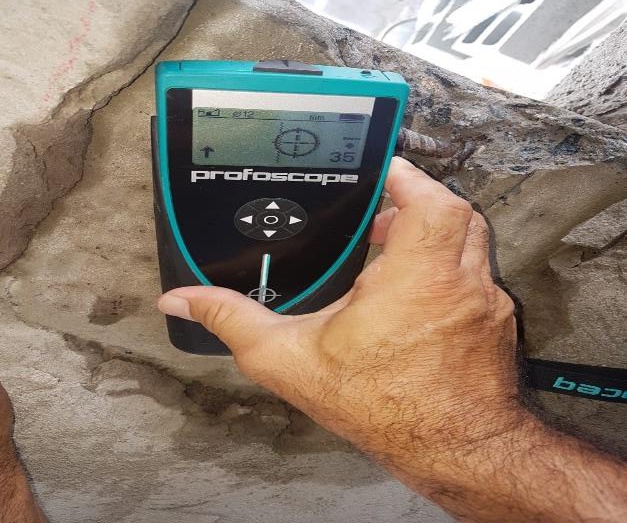
Few parts of a concrete restoration project create as much tension as quantities. A board approves a budget built on an engineer's report and a contractor's bid. Weeks later, repair areas at balconies, slab edges or garage soffits measure larger than the original numbers. Owners ask whether the estimate was wrong. Contractors explain that conditions behind the surface could not be seen. Both can be partly right, and without a measurement system nobody can prove which.
This article explains how concrete repair quantities are measured from inspection through final repair. It is written for Florida and South Florida condominium boards, owners, property managers, engineers, general contractors, estimators and construction managers. It does not teach repair design. The Engineer of Record (EOR) or responsible design professional defines repair details, acceptance criteria and engineering decisions. The contractor measures and executes within the approved documents and process.
You cannot control what you cannot quantify.
1. Why concrete repair quantities differ from new construction quantities
In new construction, quantities come from drawings. A slab has a defined thickness, a beam has defined dimensions and a takeoff can be checked against the design before work starts. Restoration is different. The work is defined by the condition of existing concrete, and much of that condition is hidden. Visible deterioration, such as spalling, cracking or rust staining, may not represent the full extent of unsound or delaminated concrete around it.
For that reason, a restoration quantity is not a single number fixed at bid time. It is a value that is refined as access improves and as concrete is opened. Quantity uncertainty is therefore a normal property of existing structures. It is different from poor estimating, which means ignoring available information, using undefined units or failing to document assumptions. A well-run project separates the two by recording what was known at each stage.
2. The four quantity stages: Estimated → Identified → Verified → Repaired
A practical way to follow restoration scope is to treat each repair quantity as passing through four stages. Each stage has a different source of information, a different level of confidence and a different record.
Quantity stages
| Stage | Typical basis | Primary record |
|---|---|---|
| Estimated | Inspection report, sampling, drawings, bid documents | Bid or baseline quantity by repair type |
| Identified | Close-up access, sounding, visual review and mapping | Mapped repair candidates with IDs and marked boundaries |
| Verified | Controlled demolition and opening-up | Measured limits after removal of unsound concrete |
| Repaired | Completed repair under the approved details | As-built quantity reconciled at close-out |
The stages do not replace one another. They create a chain. If a final quantity differs from the bid, the record should show where the difference appeared and who reviewed it.
3. Stage 1: Estimated quantities during inspection and bid
Estimated quantities usually come from an inspection report, a limited survey or a representative sample of balconies, columns or garage bays. Access at this stage is often restricted to what can be seen from the ground, from units or from limited lifts. The estimate is an informed projection, not a measurement of every repair.
A useful estimate states its basis: what was observed, what was extrapolated, which repair types and units were used and what assumptions apply. A concrete repair quantity takeoff without those notes is hard to compare with later field data. Boards should ask how bid quantities were developed, not only what they total.
4. Stage 2: Identified quantities through access, sounding and mapping
Once access is in place, the repair team can reach each surface. Concrete sounding and mapping, typically by tapping with a hammer or dragging a chain and listening for hollow sounds, help locate suspect delaminated areas. Combined with close-up visual review, sounding allows repair candidates to be marked on the structure and recorded on drawings or elevations.
Identified quantities are more reliable than estimates, but they are still not final. Sounding does not diagnose structural adequacy, and it does not show reinforcement condition or the depth of deterioration. It indicates where concrete appears unsound near the surface. Where the project documents require it, mapped areas are reviewed by the EOR before demolition begins.
5. Stage 3: Verified quantities after controlled demolition and opening-up
Controlled demolition removes unsound concrete within the marked boundary and exposes the substrate and reinforcement. At this point, the repair limit may change. Additional unsound concrete may extend beyond the mark, corrosion may continue along a bar, or the repair may need to go deeper than expected. Sometimes the opened condition is smaller than mapped.
Verified quantity is measured after opening-up, using the limits that the approved documents and the EOR's direction require. Conditions that differ materially from the documents, such as apparent reinforcement section loss, are recorded and referred to the EOR for direction. The contractor does not decide on their own that steel is adequate or that a boundary is acceptable.
6. Stage 4: Repaired and as-built quantities at close-out
The repaired quantity is what was actually completed under the approved details. It is measured under the contract's rules, recorded by repair ID and supported by photographs. At close-out, repaired quantities are reconciled against the baseline, the identified quantities and any authorized changes. A clear reconciliation lets the owner see what was planned, what was found, what was approved and what was built.
7. Common units — and why measurement rules matter more than the abbreviation
Concrete repair measurement commonly uses units such as square feet (SF) for surface or partial-depth repairs, linear feet (LF) for edges, joints or cracks, cubic feet (CF) for volume-based repairs and each (EA) for discrete items. These are only common examples. The project documents define which unit applies to each repair type.
The abbreviation alone does not settle a measurement. There is no single universal method. A written rule should state, for example, whether a square-foot repair is measured as a rectangle around the removal, along the saw-cut perimeter or as the actual irregular area; whether a minimum billable size applies; how depth categories are assigned; and how overlapping or adjacent repairs are counted. Two parties using the same unit with different rules will produce different numbers from the same repair.
8. Repair IDs and location-based tracking
Every repair should carry a unique ID tied to a location, such as building, elevation, floor, stack or bay, plus element type and repair category. The ID follows the repair through each stage: mapped size, verified size, repaired size, dates and photographs. Location-based tracking makes it possible to audit a quantity months later and to answer a simple question with evidence: which repair is this, and how did it change?
9. Photo documentation and traceability
Photographs connect numbers to conditions. A practical sequence records the condition before work, the marked boundary, the opened repair, reinforcement where exposed, the completed repair and the final finish. Each photo should reference the repair ID and include a scale or measuring tape when practical. Without traceable photos, a disputed quantity often becomes a disagreement between memories.
10. Unit prices, allowances, lump sum and discovered conditions
How quantity changes affect cost depends on the contract structure. Under unit-price work, payment follows measured quantities at agreed concrete repair unit prices, within the rules and limits of the contract. Under a lump sum, the contractor prices a defined scope, and changes typically follow the contract's change provisions. Allowances set aside budget for work that cannot be fully defined in advance. Many restoration contracts combine these structures.
Quantity growth is not automatically a change order. Whether additional work is compensable depends on the contract documents, the baseline quantities, the pricing structure, allowances, owner and EOR authorization and how discovered or changed conditions are defined. Where pricing is discussed, markup (a percentage added to cost) and margin (a percentage of the selling price) should not be confused, but the central control remains the measurement record itself.
11. How quantity changes should be approved and documented
Before demolition begins, the project should agree on a workflow for expanded boundaries and discovered conditions. A typical sequence is: record the condition with ID and photos, notify the parties named in the contract, obtain EOR direction where engineering judgment is required, obtain owner authorization where cost or scope is affected and then proceed. Concrete repair change orders should reference the specific repair IDs and measurements that support them.
01
Record
Measure the condition, assign or confirm the repair ID and photograph the marked or opened area.
02
Notify
Report the difference to the owner's representative and EOR as the contract requires.
03
Direct
The EOR provides direction on engineering matters such as boundaries, reinforcement or details.
04
Authorize
The owner authorizes cost or scope effects through the contract's approval process.
05
Execute and log
The repair proceeds and the quantity is entered in the periodic quantity log.
12. Illustrative example: a balcony edge repair
The following example is hypothetical and illustrative only. A balcony edge repair is included in the bid as an estimated partial-depth repair based on the inspection report. After access is installed, close-up sounding identifies a larger suspect boundary, which is marked and mapped under a repair ID. Controlled demolition then exposes additional unsound concrete beyond the mark, and the condition is photographed and reported. Following direction under the project process, the final repaired quantity is measured under the contract rule and recorded. There is no universal percentage that predicts this growth; each repair is measured on its own evidence.
13. Illustrative example: a parking garage repair
Parking garage concrete repair quantities often involve many repairs across slabs, beams and soffits, spread across levels and bays that must remain partly in service. In an illustrative workflow, each bay is sounded and mapped, repairs receive IDs by level and grid line, and work is phased around traffic. Daily logs record identified, opened and completed quantities by ID, so the owner can see progress and quantity trends by area rather than waiting for a single total at the end.
14. What boards and owners should require before demolition begins
- Approved repair details and repair categories
- A defined measurement unit for each repair type
- Written measurement rules
- Baseline or bid quantities with their stated basis
- Unique repair and location IDs
- Pre-demolition photographs
- Mapped or identified quantities
- An authorization workflow for expanded boundaries and discovered conditions
- A daily or periodic quantity log
- Before, during and after photographs for each repair
- EOR and owner review points where required
- Repaired or as-built quantities
- Close-out reconciliation against the contract and baseline
For buildings moving through Florida's milestone process, organizing these controls early helps connect inspection findings to a measurable repair program.
15. Where CONCRE fits
CONCRE is the restoration contractor, not the EOR. CONCRE executes approved repair documents and manages the field controls that make quantities measurable: access, repair and location IDs, sounding and mapping support, controlled demolition, quantity tracking, photo records, coordination, QA/QC and close-out documentation. When opened conditions differ from the documents, CONCRE records them and refers them for engineering direction.
Engineering and design decisions, including repair details, acceptance criteria and structural determinations, remain with the appropriate Florida-licensed professionals. CONCRE does not replace the engineer.
CONCRE observes, maps and quantifies. The Florida PE evaluates, diagnoses and specifies.
Measurable scope creates control
Concrete repair quantities will change as hidden conditions are revealed. That is the nature of restoration. What owners can control is how those changes are measured, recorded and approved. When every repair moves from estimated to identified, verified and repaired with a unit, a rule, an ID and a photograph, the final number is no longer a surprise. It is a documented result.
Related insights
More from CONCRE Insights.
Concrete spalling guide
Concrete Spalling in Florida Buildings: Causes, Warning Signs, and When Repair Is Needed
Spalling is visible concrete loss, but the condition behind it may extend beyond the broken surface. This guide helps Florida owners recognize what they can observe, what requires licensed professional evaluation, and how an engineered repair is controlled in the field.
Milestone Inspection basics
What Is a Milestone Inspection in Florida? A Guide for Condominium Boards
A Milestone Inspection is a structural inspection performed by a Florida-licensed architect or engineer. This guide explains who it applies to, when it is due, how Phase One and Phase Two work, and what a board should organize if structural repairs are identified.
Balcony restoration planning
Balcony Concrete Repair in South Florida: What Owners Should Know Before Restoration Begins
Balcony concrete restoration affects occupied units, repeated building elements, exterior access and repair quantities that become clearer at close range. The project is easier to control when scope, responsibilities and measurement rules are established before demolition.
Next step
Concrete Restoration
Share the engineer's report, repair drawings or bid quantities with CONCRE. We will review measurement units, rules, repair IDs and records needed to control the scope under the project documents.