
Insights/CONCRE Technical Note
How Much Reinforcement Has Been Lost? Understanding Residual Rebar Section in Concrete Restoration
Once concrete is opened, corrosion stops being a general observation and becomes measurable information. This note explains residual diameter, cross-sectional loss, pitting and corrosion-rate measurement — and why the Engineer of Record determines what any of it means structurally.
|9 min read
Technical Author
Sérgio Pereira Pinto Lemos, Ph.D.
Technical Advisory Team | CONCRE Restoration
Civil Engineer | Structural Pathology & Concrete Durability
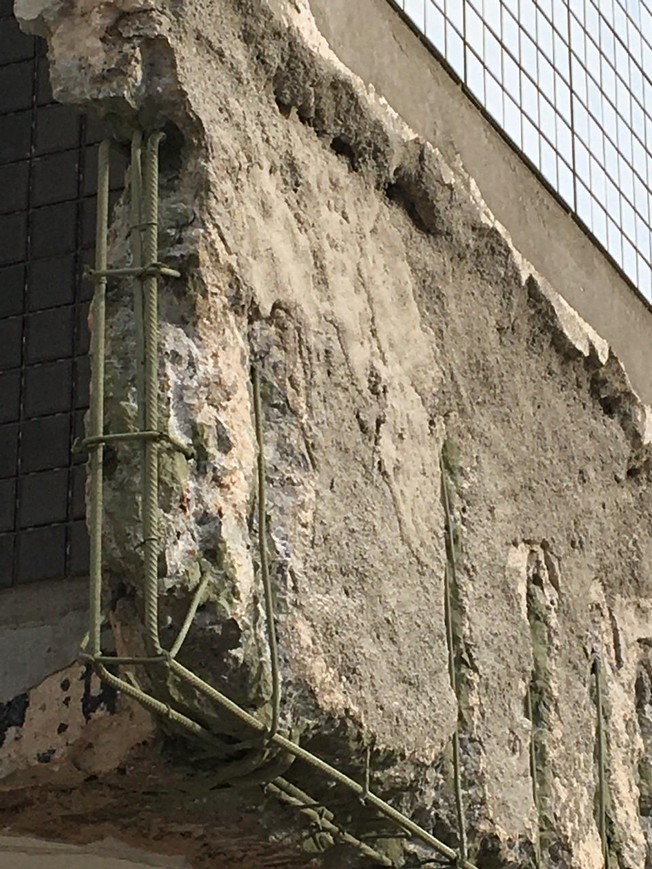
For most of a building's life, reinforcement corrosion is inferred rather than seen. Boards and managers read about rust staining, cracking along bar lines and delaminated concrete, and the discussion stays qualitative. That changes the moment deteriorated concrete is removed. With the steel exposed, the question stops being whether corrosion exists and becomes a far more useful one: how much of the original bar section is still there, where the worst loss occurs and what the pattern of attack looks like along the bar.
That information is only valuable if it is captured deliberately. Reinforcement section loss is rarely uniform, field access is temporary, and an opened area is normally closed within days. What is measured, photographed and recorded while the steel is visible becomes the permanent record of the condition. What is not recorded is gone once the formwork goes up.
CONCRE documents, maps and executes the restoration work. The Engineer of Record evaluates the structural significance of reinforcement loss and specifies repair, supplemental reinforcement or replacement as required.
Why Residual Reinforcement Section Matters
Reinforcing steel carries tension, contributes to shear resistance through stirrups and ties, confines compression zones and develops force through bond, lap splices and anchorage. All of that depends on steel that is actually present and effectively bonded. Corrosion reduces the cross-sectional area available to carry force, can disturb the bar's ribs and surface condition, and can damage the surrounding concrete that provides cover, confinement and bond.
This is why 'the rebar looks rusty' is not, on its own, an engineering statement. Light surface oxidation on an otherwise sound bar and deep localized attack that has consumed a substantial part of a stirrup leg are completely different conditions with the same general appearance from three feet away. Converting appearance into measurement is what allows the Engineer of Record (EOR) to evaluate significance rather than estimate it from a photograph.
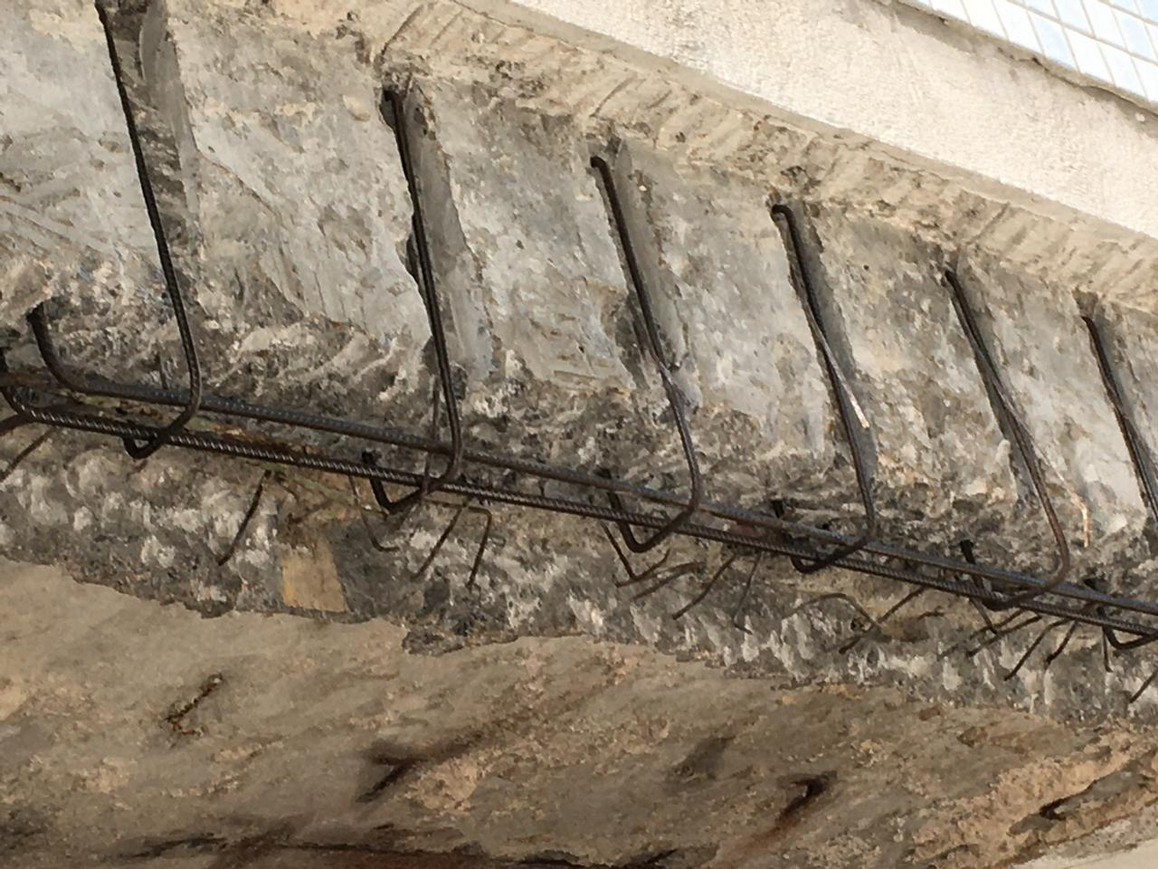
Diameter Loss Is Not Section Loss
This is the single most common misreading in the field, and it consistently understates the condition. A round bar's cross-sectional area is proportional to the square of its diameter — A = πd²/4 — so a given percentage of diameter loss always produces a larger percentage of area loss. Writing the nominal or original diameter as d0 and the measured residual diameter as dr, the diameter loss is Δd = d0 − dr, and the remaining area ratio is Ar/A0 = (dr/d0)². Area loss is therefore [1 − (dr/d0)²] × 100.
Geometric relationship only — not repair or replacement thresholds
| Diameter loss | Residual diameter (dr/d0) | Residual area (Ar/A0) | Cross-sectional area loss |
|---|---|---|---|
| 5% | 0.95 | 0.9025 | 9.75% |
| 10% | 0.90 | 0.8100 | 19.00% |
| 15% | 0.85 | 0.7225 | 27.75% |
These three lines are pure geometry for an idealized round bar. They are shown to correct an intuition, not to establish criteria: none of these values is a repair trigger, a replacement threshold or an acceptance limit in Florida or anywhere else. Real bars are deformed rather than perfectly circular, loss is seldom concentric, and the structural consequence of a given area loss depends entirely on the element, the bar's role, the redundancy available, the extent along the member and the engineering evaluation.
Generalized Corrosion Versus Localized Pitting
Corrosion is commonly described in two broad patterns. Generalized corrosion removes material relatively evenly along the exposed surface, producing a bar that is visibly thinner over a length. Localized or pitting corrosion concentrates attack in small areas, cutting deeply into the bar at discrete points while the surrounding steel may look comparatively sound. Technical literature typically handles this by relating an average corrosion penetration to a deeper local penetration through a concentration factor — a modeling convention useful for interpretation, not a field acceptance criterion, and any specific factor values in the literature should be treated as assumptions rather than universal rules.
The practical consequence is straightforward: a single caliper reading can completely miss the governing condition. Measuring one convenient point on a bar that has a deep pit two inches away produces a record that looks reassuring and is not. This is why documentation should capture both the average condition and the minimum observed diameter, and should note visually the pattern of attack — uniform thinning, isolated pits, section loss concentrated at a stirrup corner, or attack along a lap.
Documenting Exposed Reinforcement in the Field
Where project documents or EOR direction require it, field crews measure and record exposed reinforcement. Measurement is a documentation activity, not an engineering determination. A workable field routine generally includes the following.
- A location identifier tied to the repair map: element, elevation, level, grid or unit reference, so every reading can be found again.
- The nominal or original bar designation and diameter used as the basis for comparison, and how that basis was established (drawings, prior reports, adjacent sound bar).
- Preparation adequate for measurement: corrosion product and adhered cementitious material removed sufficiently to reach the steel surface, per the cleaning requirements in the project documents.
- Multiple readings along the exposed length and in more than one orientation, since loss is not concentric — appropriate measurement tools may include digital calipers, micrometers or other instruments specified by the evaluation procedure and the Engineer of Record.
- Both the representative or average residual diameter and the minimum observed residual diameter, recorded separately.
- A note on the attack pattern: generalized thinning, localized pitting, loss at stirrup legs or corners, or condition at laps and bends.
- Representative sampling across element types and bar types rather than only the most accessible or most dramatic locations.
- Photographs with a scale reference, keyed to the location identifier.
- Notification of the EOR at the hold points established by the project documents, so review occurs before the area is closed.
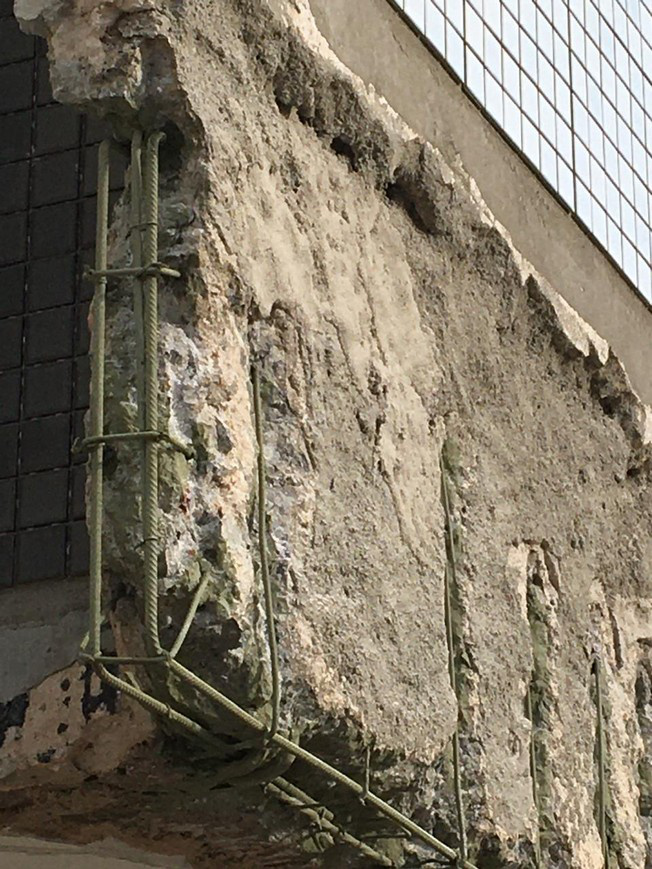
Sparse measurement is the main source of nonrepresentative conclusions, because diameter loss varies along a bar, between bars and between elements. Preselecting representative areas — especially exposed and corroded reinforcement, and cracked concrete associated with corrosion — produces a record the EOR can reason from.
What Corrosion Current Density Can and Cannot Tell Us
Electrochemical testing is sometimes used to characterize corrosion activity without removing concrete. ASTM G225-26 is a current standard practice for electrochemical measurement of corrosion rate of metals in field concrete structures. Its published scope indicates that corrosion-current measurement can provide quantitative information relevant to residual steel reinforcement section, and that integrating instantaneous corrosion current over time can be used to estimate cumulative metal loss. It also cautions that these values should be interpreted by specialists and engineers skilled in corrosion testing and structural evaluation.
Two distinctions matter for anyone reading such a report. First, a corrosion current density (Icorr) measurement is an instantaneous rate — a snapshot of how fast steel is corroding at that location under the conditions present at that moment. Second, converting a rate into accumulated section loss requires integrating that rate over time, which in practice means assuming something about how the rate behaved over years that were never measured. The measurement is real; the accumulated-loss figure derived from it is a model output.
Why 'Years Remaining' Is a Dangerous Number
Propagation-time estimates are often produced by assuming a constant corrosion rate and projecting forward until some defined loss is reached. Assuming constant Icorr is a modeling simplification, not a description of field behavior. Actual corrosion rates vary with moisture availability, temperature, oxygen supply, chloride content, concrete resistivity, cracking, cover, coating condition and seasonal cycles. A balcony soffit that is periodically saturated does not corrode at the interior rate of a dry garage column.
The source literature on this topic is itself explicit that time estimates should be interpreted cautiously. They can be useful for comparing scenarios or supporting a prioritization discussion when the assumptions are stated. They should not be presented to a board as a service-life guarantee, and they are not a substitute for engineering evaluation of the measured condition.
After Significant Section Loss Is Documented
When field measurement shows meaningful loss, the contractor's obligation is to report it accurately and promptly, with the location, readings, photographs and surrounding conditions, and to hold the area open where the project documents require review. The EOR then evaluates structural significance and determines the disposition — clean and protect in place, supplemental reinforcement, partial or full bar replacement, and the lap, development, anchorage and detailing requirements that go with it. The contractor does not decide adequacy, and no fixed percentage of section loss functions as an automatic replacement trigger.
ICRI 310.1R addresses preparation for repair of concrete deteriorated by reinforcing-steel corrosion, including exposing and undercutting reinforcement, repair of reinforcement, edge and surface conditioning and removal geometry. ICRI's 2026 guidance adds 210.5R-2026 on selecting and specifying reinforcing-bar cleaning levels and 110.1R-2026 on structural concrete repair specifications and quality assurance. These are contextual U.S. references for how such work is customarily specified; the governing requirements on any project are the ones in the engineer's documents.
Executing the Repair
01
Controlled removal
Deteriorated concrete is removed to the boundaries and geometry established by the repair documents, with access, protection and shoring as required.
02
Exposure and cleaning
Reinforcement is exposed and cleaned to the level specified, sufficient to permit observation, measurement and the specified protective treatment.
03
Documentation and EOR review
Residual diameters, pitting observations, photographs and location references are recorded and submitted at the hold points defined in the documents.
04
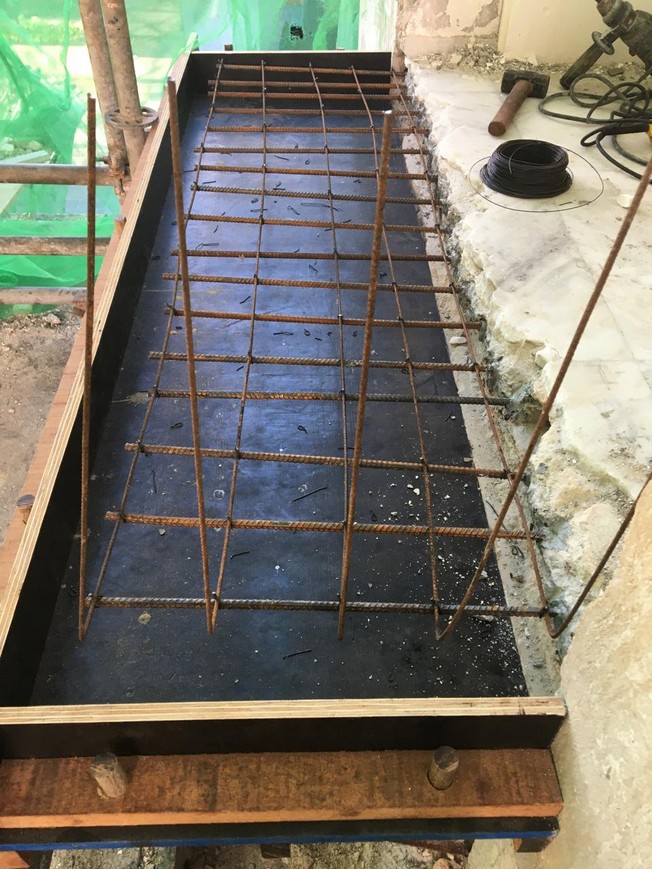
Reinforcement work
Supplemental or replacement steel, laps, couplers, ties and protective treatments are installed only as specified by the engineer.
05
Formwork and reconstruction
Forms are set and the specified repair material is placed to restore the element's profile and cover.
06
Cure and protection
Curing, protection and any specified coating or waterproofing systems are applied under the required conditions.
07
QA/QC and close-out
Inspections, quantity reconciliation, photographic records and close-out documentation are assembled for the engineer and the association.
South Florida Relevance
In marine and coastal environments, chloride exposure can be an important contributor to reinforcement corrosion, and it receives appropriate attention on buildings near the water in Miami-Dade, Broward and Palm Beach. It is not, however, the explanation for every case. Carbonation, persistent water ingress, cracking, limited or variable cover, detailing at slab edges and projections, and building-envelope failures at joints, coatings and terminations can all contribute — frequently in combination. Identifying the operative mechanism at a specific building is an engineering evaluation, not an inference from geography.
A Field Record in Practice
The value of a reinforcement record comes from its structure. Free-text notes such as 'heavy corrosion, balcony 7' cannot be reconciled, mapped or compared later; a tabular record keyed to the repair map can.
Sample only — hypothetical values for illustration, not project data or criteria
| Location ID | Element | Nominal bar | Min. residual dia. | Calculated area loss | Condition / pitting note | Photo ref | EOR disposition |
|---|---|---|---|---|---|---|---|
| B-0704-E1 | Balcony slab edge | #4 (0.500 in) | 0.470 in | 11.6% | Generalized thinning along 8 in | P-1142 | Pending EOR review |
| B-0704-E2 | Balcony slab edge | #5 (0.625 in) | 0.560 in | 19.7% | Two isolated pits at drip edge | P-1143 | Pending EOR review |
| C-0312-S3 | Column stirrup | #3 (0.375 in) | 0.355 in | 10.4% | Loss concentrated at bend | P-1187 | Pending EOR review |
| G-L2-B14 | Garage beam | #6 (0.750 in) | 0.690 in | 15.4% | Generalized surface loss; no localized pit recorded at measurement point. | P-1205 | Pending EOR review |
| G-L2-B15 | Garage beam | #5 (0.625 in) | 0.480 in | 41.0% | Deep local pit; adjacent bar sound | P-1206 | Pending EOR review |
Every value above is hypothetical. The point is the structure: each reading is locatable, each area loss is computed rather than estimated, the pitting note preserves the pattern of attack, and the disposition column keeps the engineering decision visibly with the engineer.
Conclusion
Reinforcement section loss is one of the few aspects of concrete deterioration that becomes genuinely measurable during construction — and only briefly. Treating that window as a documentation opportunity, understanding that diameter loss overstates the remaining section, accounting for localized pitting, and reading corrosion-rate results as models rather than verdicts all produce better information for the people who have to make decisions. The measurement belongs to the field record; the structural conclusion belongs to the engineer.
Related reading on how these conditions present and how repair programs are organized:
Technical Author: Sérgio Pereira Pinto Lemos, Ph.D., a member of CONCRE Restoration’s Technical Advisory Team. This CONCRE Technical Note is based on his technical work and research on corrosion of reinforced concrete structures and residual reinforcement evaluation, adapted to the U.S. concrete-restoration context with reference to current ASTM and ICRI guidance. Brazilian, fib and LNEC references cited in the underlying technical work are source context and are not presented as acceptance criteria for Florida practice.
CONCRE documents, maps and executes the restoration work. The Engineer of Record evaluates the structural significance of reinforcement loss and specifies repair, supplemental reinforcement or replacement as required.
Frequently asked questions
Is 10% loss of rebar diameter the same as 10% loss of steel area?
No. For a round bar, area is proportional to the square of the diameter, so the remaining area ratio is (dr/d0)². A 10% diameter loss leaves 0.81 of the original area — a 19% loss of cross section. A 5% diameter loss corresponds to about 9.75% area loss, and 15% to about 27.75%. These are geometric relationships, not repair thresholds.
Can a contractor decide when corroded rebar must be replaced?
No. Field crews measure, photograph and document exposed reinforcement when the project documents or EOR direction require it. The Engineer of Record evaluates structural significance and specifies repair, supplemental reinforcement or replacement, along with lap, development and anchorage requirements.
Why are multiple diameter measurements needed?
Section loss is not homogeneous along a bar, between bars or between elements. A single reading can miss a deeper pit nearby and produce a nonrepresentative record. Multiple readings in different positions and orientations allow both an average condition and a minimum observed diameter to be recorded.
What is pitting corrosion?
Pitting is localized attack that concentrates in small areas, cutting deeply into the bar at discrete points while the surrounding steel may appear comparatively sound. It contrasts with generalized corrosion, which removes material more evenly along the exposed surface. Pitting is why the minimum observed diameter matters as much as the average.
Can corrosion rate predict remaining service life?
Only within stated assumptions. A corrosion current density measurement is an instantaneous rate; estimating accumulated loss requires integrating it over time, which usually assumes a constant rate. Real rates vary with moisture, temperature, oxygen, chlorides, resistivity and other conditions, so such estimates should be interpreted cautiously and by qualified specialists.
What should be documented when corroded reinforcement is exposed?
A location identifier tied to the repair map, the nominal bar and the basis for it, the preparation performed, multiple residual diameter readings, the minimum observed diameter, a note on the attack pattern, photographs with a scale reference, and notification of the Engineer of Record at the review hold points established in the project documents.
Related insights
More from CONCRE Insights.
Milestone inspection repairs
Your Florida Milestone Inspection Identified Structural Deterioration — What Happens Next?
A Milestone Inspection report is not the end of the process. When it identifies structural deterioration, the report becomes the basis for engineering decisions, a defined repair scope, contractor execution and documented reinspection.
Concrete restoration
Concrete Spalling in South Florida Condominiums: Causes, Warning Signs & Repair
Spalling is visible evidence that concrete has separated or broken away. Understanding what can be observed, what requires professional evaluation and how repairs are executed helps condominium associations plan a disciplined response.
Quantity control
Why Concrete Repair Quantities Increase After Demolition Begins
A repair drawing marks where work is expected. Removal establishes where sound concrete actually starts. The difference between those two numbers is normal, measurable and — done properly — fully documented.
Next step
Send us the repair documents.
Engineers, associations, owners and property managers can send repair drawings, specifications, engineering reports and restoration scopes to CONCRE for execution planning. CONCRE documents, maps and executes the restoration work; the Engineer of Record evaluates structural significance and specifies the repair.