
Insights/Concrete repair
Five Questions to Ask When a Concrete Repair Keeps Failing
Patch repairs that crack again usually leave the cause behind: contaminated concrete, missed rebar, water. Five questions boards should ask.
|3 min read
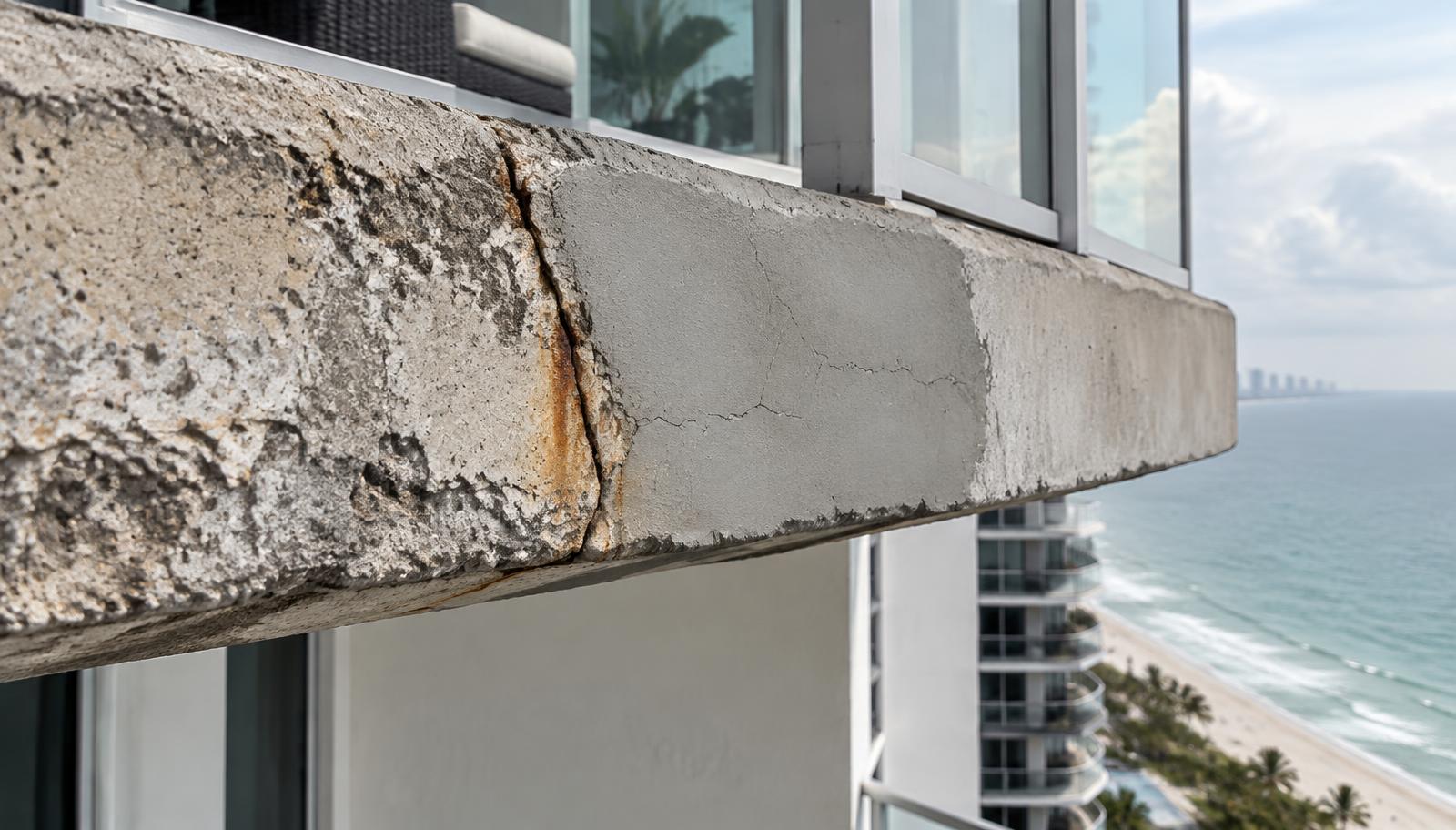
A balcony edge or garage slab is repaired, and two years later cracks and rust stains appear right next to the patch. Boards often read this as bad workmanship. Sometimes it is. More often the repair fixed the visible damage but not the cause behind it.
In most Florida condominiums, that cause is corrosion of the embedded steel, driven by chlorides, carbonation and moisture. A repair lasts only if it deals with all three: the corroded steel, the contaminated concrete around it, and the water that keeps arriving.
1. Is contaminated concrete still around the patch?
Fresh repair mortar is alkaline and protects the steel inside the patch. The old concrete just outside it may still carry chlorides. New corrosion then appears in the ring of concrete around the repair, which is why cracks often form along a patch edge. Engineers call these areas incipient anodes, and they are a known limit on how long patch repairs last.
The cause is still debated. Research on a UK car park and bridge points to residual chloride in the original concrete, effects at the interface between repair and parent concrete, and vibration damage to the bond between steel and concrete during demolition.
What to ask: how far beyond the visible damage will concrete be removed, how will the engineer decide, and which removal methods protect the bond of the bars that stay? Testing, such as chloride content or half-cell potential, can guide that decision before work starts.
2. Was the reinforcement fully exposed and cleaned?
A bar exposed on one side only, or cleaned partially, keeps corroding behind the new material. Good practice exposes the steel around its full circumference, cleans it to the standard in the engineer's documents, and measures the remaining section. Bars with significant loss may need to be supplemented or replaced. We explain how this is measured in "How Much Reinforcement Has Been Lost?"
What to ask: will the remaining bar section be measured and documented, and who decides when a bar needs replacement?
3. Is water still getting in?
A patch does not stop water. Open cracks, failed joints, worn coatings and poor drainage keep feeding the same corrosion cycle. On balconies and garages, waterproofing, joints and traffic coatings belong to the repair, not to a later add-on. See "Parking Garage Restoration" for how these trades are coordinated. For the waterproofing detail, see "Why Repaired Concrete Fails Again: Waterproofing, Joints and the Building Envelope."
What to ask: which waterproofing and joint work is in the scope, and in what order is it done?
4. Were the materials and the preparation right?
Repair mortar must be compatible with the existing concrete in strength, stiffness and shrinkage, and it needs clean, properly prepared edges and substrate. Poor bond, shrinkage cracking or short curing can make a patch debond even when the rest is sound.
What to ask: which materials are specified, who approved them, and how are surface preparation and curing verified in the field?
5. Was the scope cut to fit the budget?
Repairing only the worst areas leaves deteriorated concrete behind, and quantities usually grow once demolition begins. A low price based on drawing quantities can turn into change orders or a partial repair. Measured, approved quantities protect both the board and the contractor. See "How Are Concrete Repair Quantities Measured?"
What to ask: how are quantities measured and approved, and what happens when the opened area is larger than the survey showed?
What a durable repair looks like
A durable repair starts with an engineer-defined scope, removes concrete based on evidence rather than appearance, treats or replaces the steel, controls water, and documents every measured quantity. Each step leaves a record the board can review.
If a previous repair is failing, or your Milestone or SIRS report calls for repairs, CONCRE Restoration can review the documents, price the work from measured quantities and execute it under the engineer's direction. Contact us.
Source
Incipient anodes in reinforced concrete repairs: a cause or a consequence? — Loughborough University
Related insights
More from CONCRE Insights.
Project delivery
The Owner's Representative in Condo Concrete Repair: What Boards Should Expect
Some condo associations now hire an owner's rep to manage repairs. What the role covers, how it differs from the engineer, and how to work with it.
Building envelope
Why Repaired Concrete Fails Again: Waterproofing, Joints and the Building Envelope
A concrete repair restores a damaged element. Whether it lasts depends on what happens next to the water, salt and moisture that caused the damage.
Contract structure
Unit Price vs. Lump Sum: Choosing a Contract Structure for Concrete Restoration
Concrete repair quantities are not fully known until the concrete is opened. The contract structure decides who carries that uncertainty and how the final number is reached.
Next step
Request a Project Review
No-cost initial project review. No obligation.
No-cost initial project review. No obligation.