
Insights/Contract structure
Unit Price vs. Lump Sum: Choosing a Contract Structure for Concrete Restoration
Concrete repair quantities are not fully known until the concrete is opened. The contract structure decides who carries that uncertainty and how the final number is reached.
|4 min read
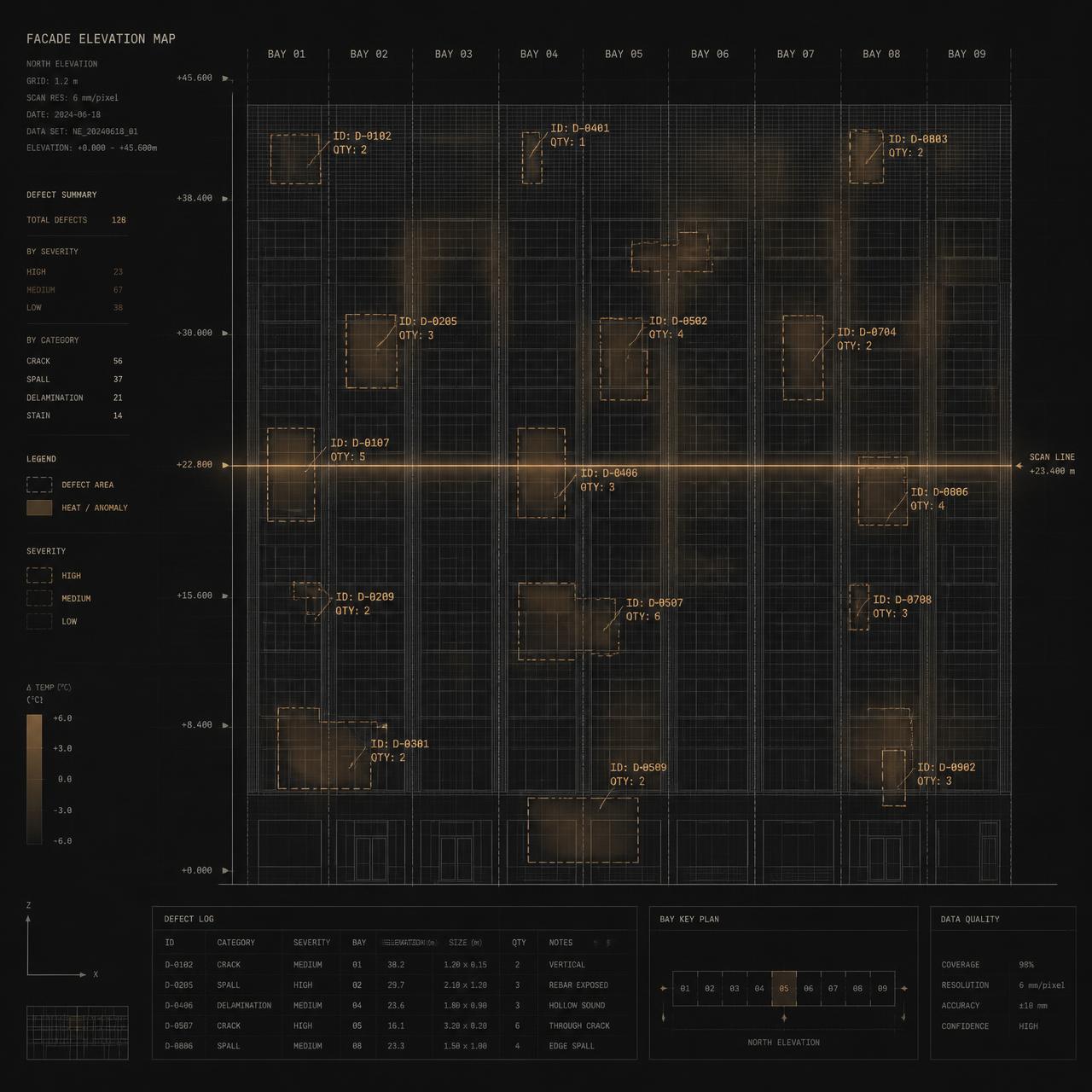
A concrete restoration contract has to price work that cannot be fully seen at signing. Sounding and visual surveys locate likely repairs, but the true extent of deteriorated concrete is established only when removal begins. How the contract treats that unknown matters as much as the price on the first page.
Two structures dominate restoration work on condominiums and commercial buildings: lump sum and unit price. Many projects combine them. Understanding what each one does with quantity risk helps a board compare proposals on equal terms.
What a lump-sum contract does
In a lump-sum contract, the contractor agrees to perform a defined scope for a fixed price. The owner gets a single number for budgeting and approval. The contractor carries the risk that the work costs more than expected.
That model works well when the scope is fully defined: a roof replacement, a painting program, a set number of railing posts. It is harder to apply to concrete repair. When the extent of deterioration is unknown, a contractor pricing a fixed sum has two options: add a margin for the unknown, or narrow the scope and price the rest as changes. Either way, the uncertainty does not disappear. It moves into contingency built into the price, or into change orders later.
What a unit-price contract does
In a unit-price contract, each repair type is priced per unit of measure: square feet of partial-depth repair, linear feet of slab edge, each for a railing embed, pounds or linear feet of supplemental reinforcement. The bid lists estimated quantities for each item. Payment is based on the quantities actually installed, measured in the field.
The AIA's general conditions describe exactly this mechanism: unit prices are quoted against estimated quantities, and the contractor is paid for actual quantities. They also allow an equitable adjustment when quantities change so much that the original unit price becomes unfair to either party. Because the owner pays for what is actually repaired, there is less reason for a bidder to pad the price for unknowns.
Engineers who prepare condominium restoration bid documents commonly recommend unit pricing for the primary repair items for this reason. The estimated quantities in the bid form then serve to compare bids on the same basis, not as a promise of the final total.
The trade-off boards need to understand
Unit pricing does not remove uncertainty from the budget. It makes the uncertainty visible and measurable. The contract value at signing is an estimate; the final value depends on what removal reveals.
| Lump sum | Unit price | |
|---|---|---|
| Price at signing | Fixed for the defined scope | Estimated: unit rates × estimated quantities |
| Who carries quantity risk | Contractor, usually priced in as contingency | Owner, paid only for measured work |
| Effect of hidden deterioration | Change orders or disputes over scope | Quantities increase at agreed rates |
| What needs controlling | Scope definition and change-order pricing | Measurement, verification and documentation |
| Best fit | Fully defined scopes | Repairs whose extent is found during removal |
Most restoration projects use both. Mobilization, access, protection and general conditions are often lump sum. Repair items whose quantity depends on what is found are priced per unit. Coatings and sealants may be either, depending on how well the area is defined.
What makes a unit-price contract work
A unit-price contract is only as reliable as its definitions and its measurement. Before approving one, a board should be able to answer these questions from the documents.
01
Is every unit defined?
Each repair type should state what it includes (removal, steel preparation, coating, reconstruction, finish) and how it is measured. A square foot of repair measured at the surface is not the same as one measured at the cut perimeter.
02
Do the quantities come from the engineer's documents?
Estimated quantities should trace back to the engineer's survey and repair details, not to each bidder's own assumptions.
03
Are all bids priced on the same quantities?
If every proposal uses the same estimated quantities, totals can be compared directly. If not, the lowest total may simply reflect the smallest assumption.
04
How is a field quantity verified?
Each repair should be located, measured before closing and approved by the owner's representative or the engineer, with photographs. CONCRE ties each location to one ID from estimate through final repair.
05
What happens if quantities change a lot?
The contract should say how large variations are handled. The AIA notes that parties sometimes agree on a percentage threshold to avoid arguing over what counts as a material change.
06
What is excluded or held as an allowance?
Items such as structural reinforcement beyond the repair details, or work behind finishes, should be named so they are not a surprise.
How the final number is reached
Under a unit-price contract, the final cost is reconciled from measured quantities. That reconciliation is straightforward when each repair has a location, a measurement, an approval and a photograph. It becomes a negotiation when it does not.
That is why quantity control is not an administrative detail. It is the mechanism that makes unit pricing fair to both sides. A board that understands how quantities move — from estimated, to identified during sounding, to verified after removal, to repaired — can follow the budget with evidence rather than with estimates alone.
Where CONCRE fits
The Engineer of Record defines the repair types, details and estimated quantities. CONCRE prices against those documents, locates and measures each repair, and documents every quantity from opening to close-out so the final reconciliation can be verified. Learn more about Quantified Restoration™ and Condominium Restoration, or request a no-cost initial project review.
This article is general information about restoration contracting, not legal, engineering or financial advice. Contract terms should be reviewed by association counsel and the engineer for each project.
Sources
Unit Price Items in Construction Contracts: Benefits & Guidelines — AIA Contract Documents
The Engineering Process Behind a Successful Concrete Restoration RFP — Campbell Property Management
Related pages
Related insights
More from CONCRE Insights.
Building envelope
Why Repaired Concrete Fails Again: Waterproofing, Joints and the Building Envelope
A concrete repair restores a damaged element. Whether it lasts depends on what happens next to the water, salt and moisture that caused the damage.
SIRS & condominium planning
Florida SIRS Deadline: What Condo Boards Must Do Before December 31, 2026
Florida law sets December 31, 2026 as the outer limit for completing a Structural Integrity Reserve Study. Here is what the statutes require now, and the practical steps boards are taking.
Local inspection repair planning
Pompano Beach Building Safety Inspections: Planning Restoration When Repairs Are Required
From reported findings to engineer-defined repairs, comparable measured bids, permits, resident coordination and the responsible professional’s reinspection.
Next step
Request a Project Review
No-cost initial project review. No obligation.
No-cost initial project review. No obligation.