
Structural Restoration
Structural Restoration in South Florida
Repair of beams, columns, slabs, walls and other load-bearing elements, executed exactly to the Engineer of Record's details, shoring requirements and sequence.
Load-bearing elements
When the repair touches the load path, the engineer leads every decision.
Structural restoration covers repairs to elements that carry load. The Engineer of Record determines structural significance, temporary support, removal limits, supplemental reinforcement and acceptance criteria.
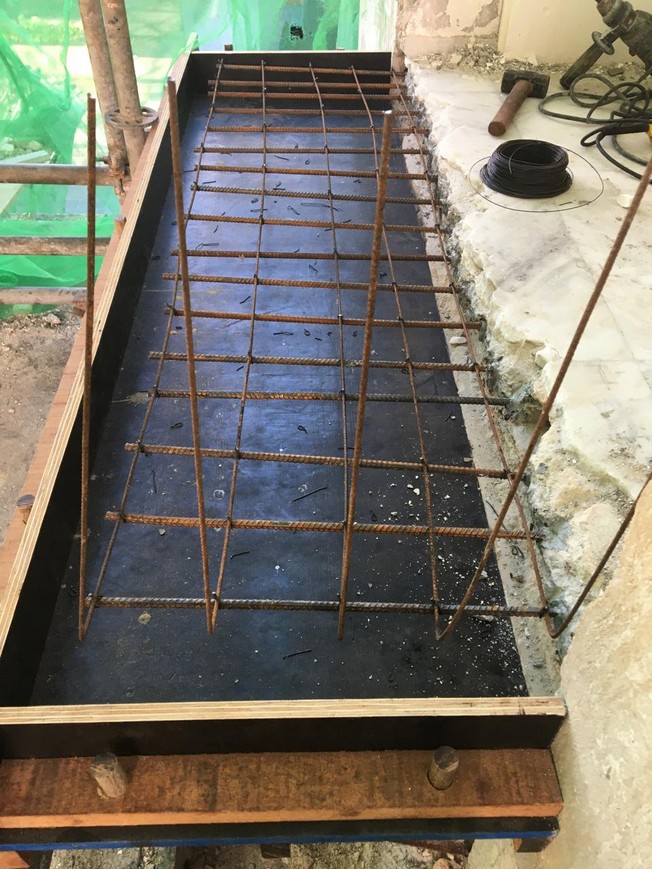
CONCRE executes those documents: installing shoring as designed, removing concrete in the specified sequence, preparing and placing reinforcement, reconstructing the section and recording every step for the EOR's review.
Surface deterioration such as spalling on non-critical façade concrete is covered on the concrete restoration page; this page is for repairs where the engineer has identified a structural element and a structural repair.
CONCRE observes, maps and quantifies. The Florida PE evaluates, diagnoses and specifies.
When it applies
Situations where a structural repair scope is issued.
Only the engineer can classify a condition as structural. These are typical contexts, not diagnoses.
Reinforcement section loss
The engineer identifies steel loss requiring supplemental bars, splices or section reconstruction.
Column and beam deterioration
Repairs to primary framing where removal must be sequenced under temporary support.
Slab and transfer elements
Structural slab, drop panel or transfer element repairs defined by the EOR.
Shear walls and cores
Repairs to lateral-system elements that require engineered sequencing.
Post-tensioned elements
Work near tendons only as the engineer and qualified specialists direct.
Milestone findings
Structural repairs identified through the statutory inspection process.
Contractor scope
What CONCRE executes on a structural repair.
Every item follows the issued drawings, specifications and EOR field directives.
Shoring and temporary support
Installation, monitoring and removal of shoring designed by the responsible engineer.
Controlled concrete removal
Removal to the specified limits and sequence, preserving reinforcement and adjacent concrete.
Reinforcement work
Cleaning, treatment, supplemental bars, splices and anchorage as detailed.
Formwork and reconstruction
Formed or hand-applied repair materials placed and cured to restore the section.
Hold points and inspections
Work paused for EOR or special-inspector observation where the documents require it.
Structural records
Photographs, quantities and as-built notes by element for the engineer's review.
Professional boundary
CONCRE does not design structural repairs.
Structural significance, load paths, shoring design and acceptance belong to the Florida PE / Engineer of Record.
When opening reveals conditions different from the documents — additional section loss, unexpected cracking or concealed elements — CONCRE stops, documents and reports to the EOR rather than resolving it in the field.
That discipline protects the building, the residents and the board's record of what was found and repaired. CONCRE serves Miami-Dade County, Broward County and Palm Beach County.
Execution
A structural repair sequence under the EOR's documents.
- 01
Document review
Repair details, shoring drawings, sequence and hold points reviewed before mobilization.
- 02
Shoring installation
Temporary support installed and verified as the shoring design requires.
- 03
Controlled removal
Concrete removed in the specified sequence and limits.
- 04
EOR observation
Exposed conditions documented and reviewed where required.
- 05
Reinforcement and forming
Steel prepared or supplemented, formwork set to the detailed geometry.
- 06
Reconstruction and release
Repair placed and cured; shoring released only when the documents permit.
Before pricing
Documents that make a structural scope priceable.
- Signed and sealed repair drawings and specifications
- Shoring requirements or shoring design responsibility in the contract
- Element list or plan locations for each structural repair
- Special-inspection and hold-point requirements
- Occupancy, parking and access restrictions around shored areas
- Unit-price structure for quantities verified after opening
Questions
Structural restoration questions.
- What is structural restoration?
- Repair of load-bearing elements — beams, columns, slabs, walls and similar components — executed to the Engineer of Record's details, shoring requirements and sequence.
- How is it different from concrete restoration?
- Concrete restoration addresses material deterioration such as spalling, delamination and reinforcement corrosion. Structural restoration is used where the engineer has identified a repair to a load-bearing element that requires engineered support, sequencing or reinforcement.
- Does CONCRE design shoring or structural repairs?
- No. Shoring design and structural repair design are engineering responsibilities defined in the project documents. CONCRE installs and executes them as issued.
- What happens if more deterioration is found after opening?
- CONCRE documents the condition and reports it to the Engineer of Record, who decides how to proceed. Quantity changes are recorded by location and handled under the contract.
- Where does CONCRE work?
- CONCRE serves Miami-Dade County, Broward County and Palm Beach County.
General information about restoration contracting. Nothing on this page is engineering or legal advice, and no building condition is diagnosed here.
From CONCRE Insights
Further technical reading.
CONCRE Technical Note
How Much Reinforcement Has Been Lost? Understanding Residual Rebar Section in Concrete Restoration
Once concrete is opened, corrosion stops being a general observation and becomes measurable information. This note explains residual diameter, cross-sectional loss, pitting and corrosion-rate measurement — and why the Engineer of Record determines what any of it means structurally.
Milestone inspection repairs
Your Florida Milestone Inspection Identified Structural Deterioration — What Happens Next?
A Milestone Inspection report is not the end of the process. When it identifies structural deterioration, the report becomes the basis for engineering decisions, a defined repair scope, contractor execution and documented reinspection.
Quantity control
Why Concrete Repair Quantities Increase After Demolition Begins
A repair drawing marks where work is expected. Removal establishes where sound concrete actually starts. The difference between those two numbers is normal, measurable and — done properly — fully documented.
Project review
Send the sealed repair documents for review.
We will review structural details, shoring, sequence, hold points and quantity structure for execution.