
Insights/Corrosion
Chloride Corrosion in Coastal Concrete: Four Stages From Invisible to Structural
How chloride corrosion moves from invisible to structural in Florida concrete, and why the early stages matter for condo boards and engineers.
|3 min read
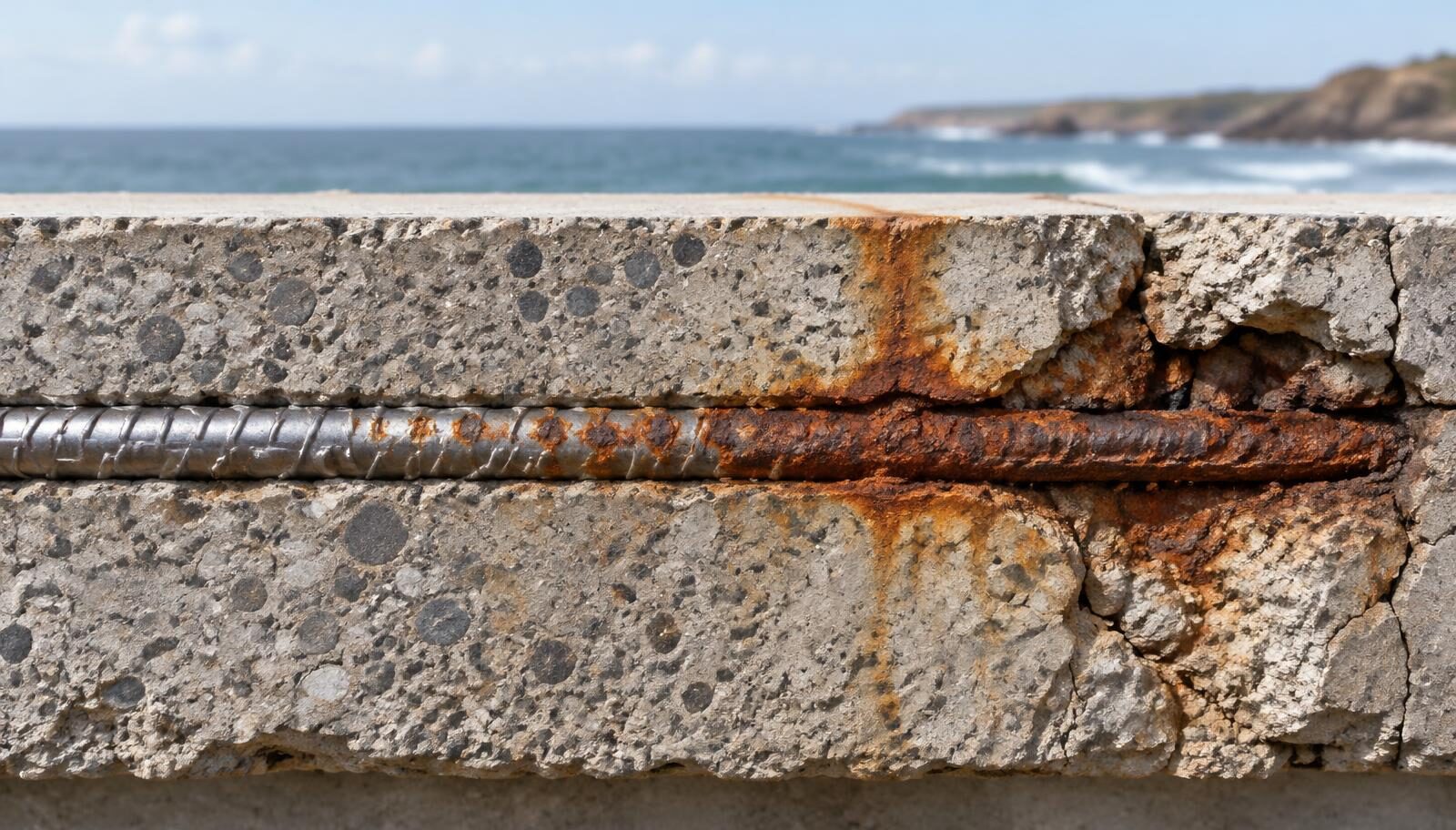
When a balcony edge spalls, it looks like a sudden event. The corrosion behind it is not. Chloride-induced corrosion of reinforcing steel is a process with distinct stages, and understanding them explains why repairs are better planned early and why visible damage is often only part of the story.
Why steel is normally safe in concrete
Concrete is highly alkaline, with a pH above 12.5. That alkalinity forms a thin passive oxide film on the steel that protects it. As long as the film stays intact, the steel does not corrode at a meaningful rate.
Chlorides, the salts that reach coastal buildings through sea air and spray, can break that film down. In chloride-induced corrosion the breakdown is local, which is called pitting, and it can produce very intense localized attack rather than uniform rust.
Two periods, four critical points
Engineers describe the life of reinforced concrete under corrosion as two periods:
- Initiation: chlorides penetrate the cover until enough of them reach the steel to break down the passive film.
- Propagation: corrosion is active, an electrochemical process whose rate depends on factors such as oxygen availability and the electrical resistivity of the concrete.
Within those periods, a Lund University document on corrosion service life identifies four points where a structure can be judged to have reached a critical condition:
- 1. Initiation of corrosion. The passive film has broken down. Nothing is visible.
- 2. Corrosion products become visible. Rust staining appears on the surface.
- 3. Cracking or spalling. Corrosion products can crack the cover, and the concrete can spall. This is the stage most boards notice.
- 4. Serious loss of bearing capacity. Enough steel section has been lost to reduce the structure's capacity. For how engineers estimate that loss, see How Much Reinforcement Has Been Lost?
The same source notes that traditional service-life thinking considers only initiation, while design could instead use stage 2 or 3 as the limit.
What sets the clock
The chloride concentration needed to start corrosion is called the chloride threshold. It depends on many parameters, and the source notes that reported values vary widely between studies and national codes. That is one reason a rule of thumb is a poor substitute for testing a specific building.
The source also notes that initiation can be rapid when the concrete has cover defects, such as thin or cracked cover. In those cases the corrosion rate, not the time to start, becomes the critical factor.
What this means for boards
- Visible damage is the third stage. By the time concrete spalls, corrosion has been active. That is why openings often reveal more than a visual survey suggested. See Parking Garage Concrete Deterioration and Concrete Spalling in Florida Buildings.
- Water pathways matter. Chlorides travel with moisture, so envelope and waterproofing conditions influence how fast problems develop. See Why Repaired Concrete Fails Again.
- Early evaluation is cheaper than late repair. A condition review before the milestone age gives the board a baseline to plan against. See Don't Wait 30 Years.
- Ask what was measured. Reports that distinguish cover, chloride exposure and steel condition give the board better information than a note that concrete is deteriorated.
Next step
If your building shows rust staining, hairline cracking or early spalling, an engineer's evaluation will tell you which stage you are in. CONCRE Restoration can support the process with measured quantities and a phased repair plan. Contact us at concrerest.com/contact.
Source
Related pages
Related insights
More from CONCRE Insights.
Milestone inspections
Phase Two Milestone Inspection: Understanding Florida's 365-Day Clock
A plain-language guide for Florida condo boards to the milestone inspection timeline: 180-day reports, owner notices and the 365-day repair clock.
Concrete repair
Five Questions to Ask When a Concrete Repair Keeps Failing
Patch repairs that crack again usually leave the cause behind: contaminated concrete, missed rebar, water. Five questions boards should ask.
Project delivery
The Owner's Representative in Condo Concrete Repair: What Boards Should Expect
Some condo associations now hire an owner's rep to manage repairs. What the role covers, how it differs from the engineer, and how to work with it.
Next step
Request a Project Review
No-cost initial project review. No obligation.
No-cost initial project review. No obligation.